Lavender Documentation
Lavender Terminal — $390 / seat / month
The Windows desktop app for options traders. Works on Lavender's paper book out of the box — nothing to configure. 7-day free trial (credit card required) at lavender-ts.com/terminal; download at download.lavender-ts.com/Terminal.exe. Terminal overview →
Lavender Gateway — $450 / instance / month
The REST API for developers and quants. Up to 3 users, month-to-month. Product overview and pricing →
Gateway 7-day free trial
Try the full Gateway on your machine for 7 days, free. Credit card required. Start at gateway.lavender-ts.com →
Try free first via Discord
Run /greeks, /skew, /term, /surf, and four more slash commands on any OPRA-listed ticker -- 100 commands per day free, no credit card, same engine that powers Gateway. Discord guide →
Excel user? Skip the API
Lavender works directly in Excel via Power Query, a copy-paste VBA module (=LavDelta(...) formulas), or a browser-rendered HTML format -- no API code required. Excel guide →
Lavender computes option Greeks independently — dividend-aware, early-exercise-aware, with calibrated forward prices — ticking continuously across the full OPRA universe (~6,000 names). One engine powers three products: Lavender Terminal, a desktop options workstation; Lavender Gateway, a local REST API; and Lavender Discord, free on-demand volatility analytics. Whichever you use, you work from the same numbers, computed the same way.
Lavender Terminal
The Windows desktop workstation for options traders — a live option-chain Montage, a spinnable 3D volatility surface, a wall of analytical charts, whole-book positions and risk, scenario analysis, and a multi-leg trade ticket, all on Lavender's own independently computed Greeks. It opens on Lavender's paper book out of the box — nothing to configure — and lights up with your live positions when you connect the broker and market-data feed you already use.
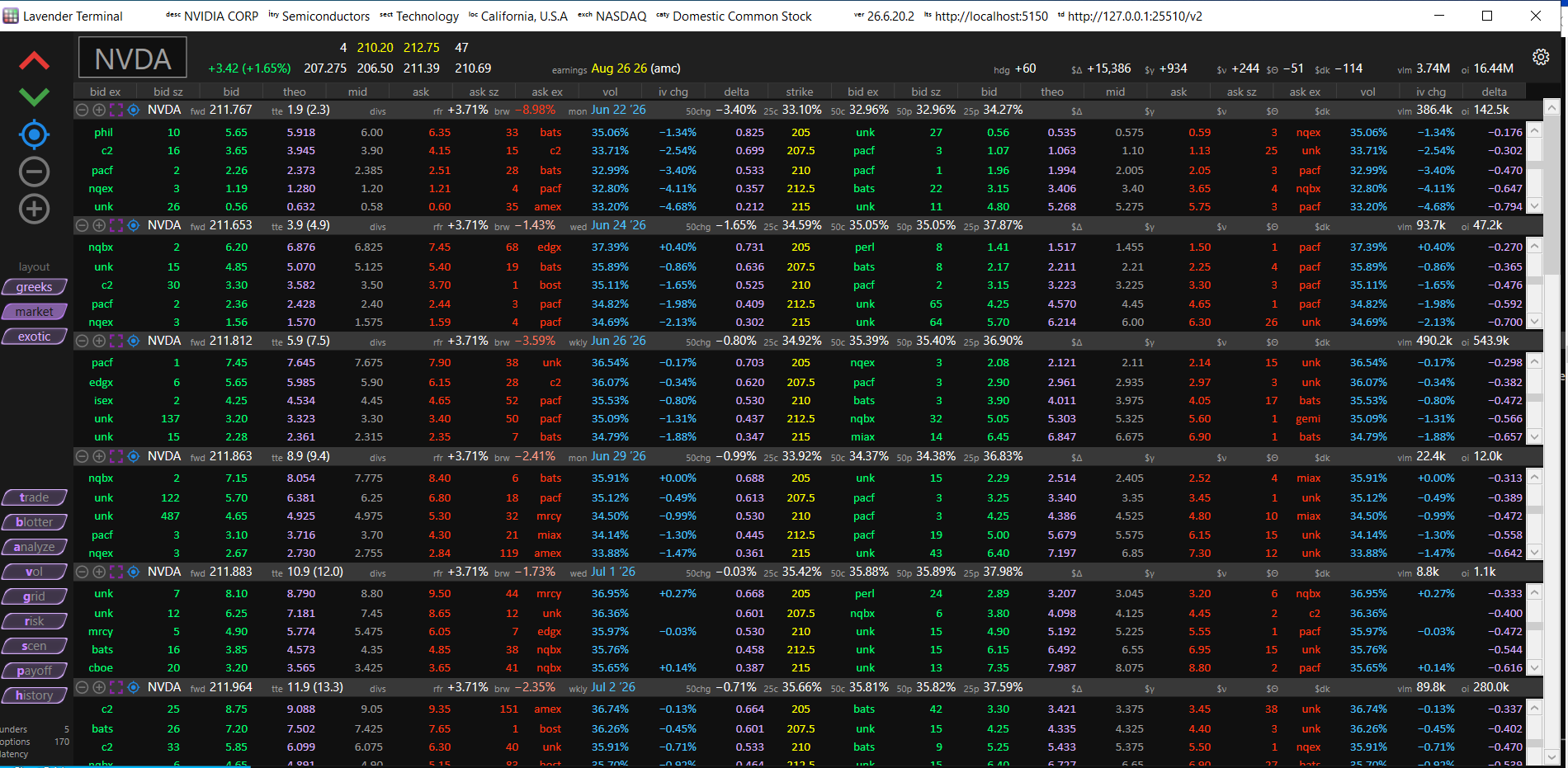
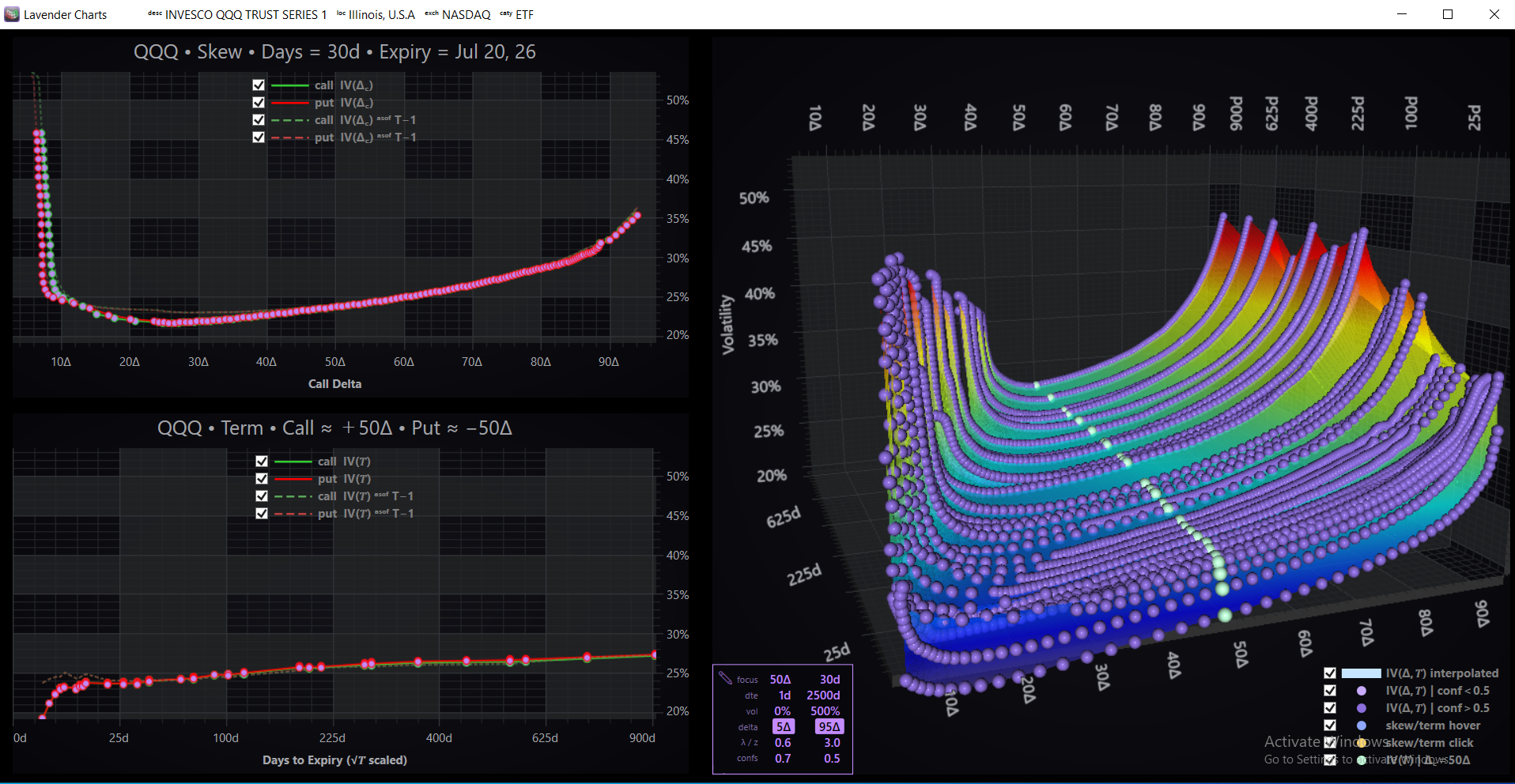
7-day free trial (credit card required) at lavender-ts.com/terminal — $390/seat/month, month to month, no exchange fees. Terminal overview →
What is Gateway?
Gateway is a long-lived program -- a single binary you run on your machine and leave running. It serves the Lavender API and nine vendor-compatible endpoints (Alpaca, AlphaVantage, Intrinio, LiveVol, MarketData.app, Orats, Polygon.io, ThetaData, Tradier) on localhost:2112.
Runs on Windows 10+, macOS 12+, and Linux (x64). Download the binary for your OS, run it.
Quick Look
Once Gateway is running, open this in any browser:
The at-the-forward call and put for every SPY expiry, rendered as an HTML table. Change the symbol and refresh. No API key needed. See Quickstart to get set up.
Works with Your Existing Code
Lavender provides compatibility layers for major option data vendors. Your existing code works unchanged — just point it at Gateway running on localhost:2112. No API key needed; any existing vendor auth headers stay on your machine and are silently ignored.
curl -H "APCA-API-KEY-ID: YOUR_KEY" -H "APCA-API-SECRET-KEY: YOUR_SECRET" \
     "https://data.alpaca.markets/v1beta1/options/snapshots/AAPL"
#      ^^^^^^^^^^^^^^^^^^^^^^^^^
curl "http://localhost:2112/v1beta1/options/snapshots/AAPL"
#     ^^^^^^^^^^^^^^^^^^^^^^^^^^^
Swap the host. The Alpaca auth headers are accepted and ignored.
curl "https://www.alphavantage.co/query?function=realtime_options&symbol=AAPL&require_greeks=true&apikey=YOUR_KEY"
#     ^^^^^^^^^^^^^^^^^^^^^^^^^^^                                                                 ^^^^^^^^^^^^^^^^
curl "http://localhost:2112/query?function=realtime_options&symbol=AAPL&require_greeks=true&apikey=YOUR_KEY"
#     ^^^^^^^^^^^^^^^^^^^^^^^^^^^
Swap the host. Your apikey parameter is accepted and ignored — leave it or remove it.
curl -H "Authorization: Bearer YOUR_INTRINIO_KEY" \
     "https://api-v2.intrinio.com/options/chain/AAPL/2026-12-18/realtime?show_stats=true"
#      ^^^^^^^^^^^^^^^^^^^^^^^^
curl "http://localhost:2112/options/chain/AAPL/2026-12-18/realtime?show_stats=true"
#     ^^^^^^^^^^^^^^^^^^
Swap the host. Your Intrinio API key is accepted and ignored.
curl -H "Authorization: Bearer YOUR_LIVEVOL_TOKEN" \
     "https://api.livevol.com/v1/live/allaccess/market/option-and-underlying-quotes?symbol=AAPL"
#      ^^^^^^^^^^^^^^^^^^^^^^^^^^^^^^
curl "http://localhost:2112/allaccess/market/option-and-underlying-quotes?symbol=AAPL"
#     ^^^^^^^^^^^^^^^^^^
Swap the host. Your LiveVol auth header is accepted and ignored.
curl -H "Authorization: Bearer YOUR_TOKEN" \
     "https://api.marketdata.app/v1/options/chain/AAPL"
#      ^^^^^^^^^^^^^^^^^^^^^^^^^
curl "http://localhost:2112/v1/options/chain/AAPL"
#     ^^^^^^^^^^^^^^^^^^^^^^^^^^^
Swap the host. No API key needed; any bearer token you send is ignored.
curl -H "Authorization: Bearer YOUR_ORATS_TOKEN" \
     "https://api.orats.io/datav2/strikes?ticker=AAPL&dte=0,30"
#      ^^^^^^^^^^^^^^^^^
curl "http://localhost:2112/datav2/strikes?ticker=AAPL&dte=0,30"
#     ^^^^^^^^^^^^^^^^^^^^^^^^^^^
Swap the host. Your token parameter is accepted and ignored.
curl -H "Authorization: Bearer YOUR_POLYGON_KEY" \
     "https://api.polygon.io/v3/snapshot/options/AAPL"
#      ^^^^^^^^^^^^^^^^^^
curl "http://localhost:2112/v3/snapshot/options/AAPL"
#     ^^^^^^^^^^^^^^^^^^^^^^^^^^^
Drop the auth header or leave it — either way works.
curl "http://localhost:25510/v3/option/snapshot/greeks/all?symbol=AAPL&expiration=*"
#                  ^^^^^
curl "http://localhost:2112/v3/option/snapshot/greeks/all?symbol=AAPL&expiration=*"
#                  ^^^^
Change the port. Same path, parameters, and response format. Both v3 and v2 wire formats supported.
curl -H "Authorization: Bearer YOUR_TRADIER_TOKEN" \
     "https://api.tradier.com/v1/markets/options/chains?symbol=AAPL&expiration=2026-12-18&greeks=true"
#      ^^^^^^^^^^^^^^^^^^^^^
curl "http://localhost:2112/v1/markets/options/chains?symbol=AAPL&expiration=2026-12-18&greeks=true"
#     ^^^^^^^^^^^^^^^^^^^^^^^^^^^
Swap the host. Your Tradier auth header is accepted and ignored.
Lavender Discord
Run the engine with simple slash commands — /surf, /skew, /term, /greeks and more — and get instant volatility charts on any OPRA-listed ticker, right in Discord. Free, 100 commands per day, no setup. Discord guide →
Verify Every Greek
Every number the API returns is reproducible from first principles. Paste our Black-76 reference implementation into Python, R, or Excel and match Lavender to within 0.01% on European options — fully transparent, fully verifiable.
Compare Risk Side-by-Side
Two risk reports built on different assumptions is powerful. Lavender and your existing provider will often agree on the big picture — but where they diverge, you gain insight from both views.
- If your provider uses simplified assumptions — many platforms rely on continuous dividend yields, European-style pricing, or fixed/zero borrow rates. Lavender uses discrete dividends, early-exercise handling, and borrow-aware forward prices. Comparing the two highlights where those simplifications cost you.
- If you're already on a sophisticated platform — an independent second source still matters. Different models make different assumptions. Where two good models agree, you have confirmation. Where they diverge, you have a signal worth investigating.
- Two views of time decay — conventional theta (\(\partial V / \partial t\)) on every endpoint, plus a separate decay metric on the Lavender API that measures the expected price change to the same time on the next trading day, accounting for weekends and holidays.
- Redundancy — a fully independent Greeks source if your primary provider has downtime or performance issues.
- Same wire format — Lavender speaks your vendor's protocol, so you can run both side-by-side with zero integration effort. Compare Greeks contract-by-contract.
Which API Should I Use?
| If you... | Start here |
|---|---|
| Are starting fresh | Lavender API — the primary API, with extended Greeks, field selection, term structure, and filtering |
| Have existing Alpaca code | Alpaca compatibility — same options snapshots endpoint and JSON structure |
| Have existing AlphaVantage code | AlphaVantage compatibility — same Realtime Options endpoint and JSON envelope |
| Have existing Intrinio code | Intrinio compatibility — same options chain endpoint and JSON structure |
| Have existing LiveVol code | LiveVol compatibility — same option quotes endpoint and JSON structure |
| Have existing MarketData.app code | MarketData.app compatibility — same chain and quotes endpoints, columnar JSON |
| Have existing Orats code | Orats compatibility — same strikes data endpoint and JSON structure |
| Have existing Polygon.io code | Polygon.io compatibility — same option snapshots endpoint and JSON structure |
| Have existing ThetaData code | ThetaData compatibility — v3 and v2 snapshot endpoints, wire-compatible |
| Have existing Tradier code | Tradier compatibility — same option chains endpoint and JSON structure |
The vendor compatibility layers let you migrate existing code with a one-line host change. The Lavender API is the primary protocol — it exposes the full feature set and is the recommended starting point for new integrations.
Learn More
-
Lavender Terminal
The Windows desktop app for options traders — a live option-chain Montage, a 3D volatility visualizer, a wall of analytical charts, full positions and risk, scenario analysis, and a trade ticket. Opens on Lavender's paper book out of the box; connect your own data and broker when you're ready.
-
Lavender API
The primary API — extended Greeks through third order, field groups, term structure support, filters for strike / DTE / delta / moneyness, sort and limit, and four output formats including browser-rendered HTML.
-
Greek Conventions
Sign conventions, units, and the extended Greeks (second and third order) available through Lavender.
-
Market Data & Reliability
Where Lavender's market data comes from, why you don't need an OPRA license to run Gateway, and the local-binary architecture's reliability properties.